
The next few blog posts are a few of my newest favorite resources for teaching. These are screencasts of me demonstrating how to use them.
Apr 5, 2015
Changing the Story…Changing the Learning
By · Leave a Comment

Slowly but surely my (errr, my school’s) maker space is coming together. It has been one of my favorite weeks in recent memory as I have had lunch dates with my fifth graders as we constructed circuits and coded Sphero (or as it is now named Mosk-o).
The amazing moments of learning and thinking and problem-solving during these two hours this week are too numerous to begin to mention them all, so I will share a few.
The first began when we made the first circuit actually work and the light lit up on its own. There were shrieks of happiness in the media center. It’s been a long time since I have heard such a vibe of excitement in students. The vocabulary that they used as they read the workbook that came with our Circuit Scribe and created lights of varying colors as well as sound and changed the volume….you’d have to hear it to believe it!
Then two of them with birthdays approaching said they would have to ask for a kit –imagine that, science kit for their birthday. Imagine that.
These students wouldn’t leave for recess. It was the first nice day in a long time. That’s right. No outdoors. Just circuits for them.

Today’s lunch involved Sphero, a ball that one controls with an app and some basic computer coding. Once we had the the hang of it, we were chasing it through the halls of the school. They learned to control it, move it, make it spin, and change the color.
Definitely computer coders in the making…
Looking forward to what post-spring break holds!
Mar 22, 2015
The Future
By · 1 Comment

Attribution 2.0 Generic (CC BY 2.0) by Celestine Chua
How do we begin to prepare our students for a future that we don’t know? Jobs that don’t yet exist?
This is what we face in schools today. This is our reality. Yet we continue to teach this curriculum that looks a lot like the one we learned decades ago that was similar to the one our grandparents learned before we did. How do we truly transform our education system rather than just making little tweeks here and there –adding a computer or a Smartphone or becoming BYOT.
Don’t get me wrong. These are important components. But to truly meet the needs of our students, we must prepare them to be ready to create, communicate, and think like never before. We know from the business world of today that the students coming to them are compliant; but they don’t want compliant –they want graduates who can think and figure it out on their own. Adults who don’t need constant direction. Adults who lead initiatives.
Our schools need change.
We keep saying this, but it will take bold leaders to stand up for our students.
It will take educators to give our schools back to our children.
It will take our country to stop using our students as negotiation tools in politics.
Jan 28, 2015
A Present Worthy of our Children
By · Leave a Comment

Attribution-NonCommercial-ShareAlike 2.0 Generic (CC BY-NC-SA 2.0)
Photo by David Truss
Most of us go through our day as educators and see things we’d like to tweak here and there: maybe a different strategy, a better schedule, a different technology. For me, I’d like to see a transformation of the way we do things. I see us as still looking so much like centuries ago –still preparing our students to be compliant, factory-line citizens rather than problem-solving creators that the world of today and tomorrow require.
1. Space: sure, many of our classrooms have changed from using desks to using tables. I wonder why we even do this. How many adults work at tables, crammed into a small space with other adults. Is this a place that we would be comfortable working? I work best on my couch with my legs propped onto my ottoman, for example. Not everyone is like me, but if we are to meet all learning styles and prepare students for life, should we have more alternative seating than just tables and chairs.
Additionally, our classrooms are still, well, classrooms. They are rather restrictive with space. The hallways waste so much usable space that could be used.
2. Speaking of hallways, most public schools insist that students walk in silent, straight lines. I wonder what we are accomplishing with this. If we taught them to walk on the right side of the hallway, and speak softly, they wouldn’t be disrupting classes. I can’t help but think we would accomplish a better goal.
3. Curriculum: when will we revisit what students need to learn. When Google can tell us every fact out there, we need to teach thinking, problem solving, creation. Everything we know about school truly must be revisited. We are losing our students and time by teaching concepts that they don’t need to know and won’t ever use. I believe that we could be making so much better use of time in school.
Jan 27, 2015
The Lives that our Students Live
By · Leave a Comment

CC0 1.0 Universal
Real life is often the opposite of school, but does it have to be? What if school learning mirrored the skills that students need for life rather than being something so vastly different?
That would take some real change in our current school structure. New tables and new technologies do not make a twenty-first century school (ugh, how I dislike that term). Making the shift from our teachers covering material to students uncovering material is certainly a daunting one at times. It seems like we have been talking about integrating the subjects and students learning through the process of PBL for so long and yet, it is taking us in the world of education a long time to roll out these concepts.
I look forward to continuing the forward momentum in education of making our schools look more like life –the life where they live, so that learning is authentic and students enjoy the process of creating, thinking, and problem solving.
Sep 28, 2014
You are as Great as the Cause you Serve and as Young as Your Dreams
By · Leave a Comment
As educators in the year 2014, we constantly hear and read about this growth mindset. It is so much embedded in our culture. This video has been passed around the internet and highlights Shimon Peres, at what some might believe is the end of his career at the age of ninety-one. Contrary though, he is job hunting in the video. It shows the skills he has learned throughout his life and how they have prepared him for potential jobs: gas station attendant, skydiving coach, cow milker, and stand-up comedian.
I was happily surprised last week to hear this video and the idea of us always being in progress as the topic of my rabbi’s sermon. But what can we as educators get from this? At this time of the year, religiously I reflect on my life. How can I be a better person? How can I be better spiritually?
I am constantly doing the same as an educator. I have been meeting with my staff to help them set goals for the year to help each of the grow professionally and determine their focus for the year.
As I sat in services last week, my rabbi challenged each of us: are you done or in progress? To me it sounded like the work of Carol Dweck in MindSet; it just goes to show how much overlap there is in our worlds.
Being in progress isn’t just for us as educators but us as human beings.
So in the words of Shimon Peres, former President and Prime Minister of Israel, “You are as great as the cause that you serve and as young as your dreams.”
Are we done or are we always in progress?
Aug 10, 2014
My Journey To Connectivity
By · 2 Comments

It sometimes can be overwhelming trying to utilize all the technology tools out there. About a year ago I began using Twitter on a regular basis to connect with professional educators all over the world. That has led me to this world of connected educators that I would never have known was out there.
Because of Twitter, I have increased my blog reading and writing. I have learned to become more transparent in my practice and write about it in my blog. I set goals and try to write more (although I often don’t meet those blogging goals as you can see by the sparseness of my blog postings). I do have so much to say, but finding the time to write, revise, edit, and perfect (this perfectionist cannot stand to post without the last step) is difficult.
I’ve learned so much by participating in Twitter chats. It still amazes me that a year ago I didn’t know that such a things existed! I’ve modeled these for the teachers in my building hoping that they will see the personalized professional learning they can gain from the chats. For me a weekend doesn’t start off on the right foot without my SATCHAT….I mean, I was in Puerto Rico, waiting for a ferry to Culebra with limited cell service and managed my SATCHAT…it’s that important! Other weekly highlights for me as an administrator are edtechchat, teach like a pirate (TLAP), teacher/parent chat, 1 to 1 i pad chat, BYOT Chat, Georgia Educator, Iowa Educator (yes, I live in Georgia, but Iowa has some good topics!), and whatisschool. There are countless others; these just happen to work for my schedule and be some of my favorites! In many cases I have developed friendships and professional relationships online first that then became face-to-face friendships at conferences like ISTE and FETC. It’s amazing what technology has become!
Through my growth and learning on Twitter which has lead me to individual educators’ blogs, I then began to curate through Flipboard and organize blogs through Feedly. This has led me to even more educators and blogs thus more connectivity.
My latest is Voxer. I participate in a number of Voxer groups. What’s nice about this is the more personalized nature of it because I can hear people’s voices. With Twitter and Blogs we only read words; with Voxer I can hear which gives an additional layer of personalization to the app. I just think there is something convenient about talking rather than typing.
What is your story? How have you or will you get connected? Does it make us better educators?
Aug 1, 2014
Who Are We?
By · 1 Comment
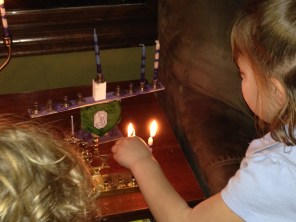
Who are we? Where do we come from? What makes us who we are? Is it nature or nurture? For me, my family and the traditions that I was brought up with are so much of who I am that it is engrained in everything that I do.
I believe that I should be better today than I was yesterday.
I should have a disregard for the impossible.
My Bubeh and Zayde (great grandparents) came from Russia as young adults. As a child, I used to walk my Bubeh to the restroom because she couldn’t read English. In spite of not having a formal education, she raised four children. When school called, she had learned the formal system; she showed up, and whatever that teacher said was right! And boy oh boy, you didn’t mess with her! All that in spite of not reading. That perseverance came in handy; I remember her telling stories of the Cossacks raiding her village time after time as a child growing up.
My grandmother: she was the kid whisperer. Even though she wasn’t the most social person, she could strike up a conversation with any child whether we were in line at a store or wherever. She had an innate ability to bond immediately with them. When my sister and I both became teachers, she started buying books for each of our classroom libraries because, “They need to learn to read!”
She became a widow way too young and got the equivalent of a minimum wage job to support her four young children; she saw to it that each made it to college graduation. Her youngest, much to her dismay had a dream of being an actor. But she saw to it that he lived out that dream and went to Juliard on a full-ride scholarship to live out that dream -it wasn’t her dream but what her children wanted she saw to!
So how does this connect to my vision of education and to me?
That risk-taking of my grandma and bubeh?
As a first-year teacher I found myself in the inner-city where most of my second-grade students couldn’t read the pre-primer words. Innovation was where it was. The grade level text wasn’t going to cut it. Business as usual wasn’t cutting it for those kids. I knew that like my family before me I was going to have to take a risk and do it differently and get my students through several years of school in one year. Because after all, we all know the research: jail cells in Georgia are built based on the number of third-grade students not reading on grade level…and I wasn’t going to let my babies be part of that statistic! So as a twenty-two year old fresh out of college I broke the mold and I set the course for my career.
I was going to be a risk-taker. I was going to be an innovator.
These are beliefs that I have never stopped.
I have lived my educational career this way. I believe in this growth mindset. This is the legacy that I want to leave. We have to be innovators if we want our students to be.
What if we all committed to learning together? To innovating together? To figuring it out together.
Jul 23, 2014
Beginning of the School Year Message
By · 1 Comment
CC0 1.0 Universal (CC0 1.0) by Gerd Altmann
As the new school year is starting, I have so many things that I want to share with teachers. Here is my (for now) consolidated list.
1. Don’t be afraid to take risks in your classroom. We don’t learn and become better educators, or better people for that matter, unless we take a chance. There will be times that we will fail; it is in those times that we learn the most, though. Pick yourself up, be reflective, be transparent, and move on.
2. Build great relationships. Relationships are the first step to having a well-run classroom. Without trust from students and parents, it is difficult later to engage students in learning and discipline students when necessary. You don’t want me as the administrator to have to save the day often because that weakens what you have established in your own class. Also, build relationships between your co-workers. We spend so much time together and rely on one another. Collaboration and teamwork is imperative. You are one another’s most amazing resource.
3. Become connected. This term has a whole new meaning today! With Twitter it is so easy to collaborate with people across the country and the world. I have made friendships that I never before imagined due to social media. I have learned so much from connecting through Twitter; from read my feed and from participating in weekly chats. Find some that apply to you and it’s personalized learning at its best! Start small and follow a few people and lurk if you are unsure. Join in a content or grade level chat. You will be amazed at how much you will learn. Now I have discovered Voxer and Voxer chats which have opened up a new world of voice collaboration.
4. Find one new idea that you will try with fidelity and use well all year long. Maybe it’s Edmoto, Remind, Evernote, Padlet. Whatever it is, commit and use it well all the time –not just every now and then.
What do you think is the message we need to give teachers? What is most important as we open the new academic year?
Jul 15, 2014
Themes from ISTE2014
By · Leave a Comment

Post-ISTE my brain has been spinning–so many amazing ideas to make my way through. But that wasn’t before a long-needed vacation in Puerto Rico. There’s nothing like some time on the beach to sort through my notes and figure out my next steps.

The one theme that held true for me at ISTE2014 is something I’ve always believed in: that it is about the children, our students. The content and the technology are the way that we engage them, but the teaching and the relationships are the most important thing in our field! Without relationships with the students in our classrooms we have nothing. Without relationships with the teachers around us we have nothing. Without relationships with our PLN we are less than we were before.
I believe so strongly that passion is the first thing we have to have as educators –whether we are teachers or administrators. The content-knowledge and the technology-knowledge help us deliver the information and reach our students but without that love for our students and that passion for what we do….it won’t matter a bit what we know.
So with these thoughts, I will continue to sort through all my session notes.


 Innovate * Inspire * Lead Change