
Who Are We?

Opening Slides

IMG_0618

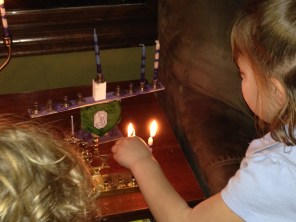
Who are we? Where do we come from? What makes us who we are? Is it nature or nurture? For me, my family and the traditions that I was brought up with are so much of who I am that it is engrained in everything that I do.

I believe that I should be better today than I was yesterday.

I should have a disregard for the impossible.

My Bubeh and Zayde (great grandparents) came from Russia as young adults. As a child, I used to walk my Bubeh to the restroom because she couldn’t read English. In spite of not having a formal education, she raised four children. When school called, she had learned the formal system; she showed up, and whatever that teacher said was right! And boy oh boy, you didn’t mess with her! All that in spite of not reading. That perseverance came in handy; I remember her telling stories of the Cossacks raiding her village time after time as a child growing up.

My grandmother: she was the kid whisperer. Even though she wasn’t the most social person, she could strike up a conversation with any child whether we were in line at a store or wherever. She had an innate ability to bond immediately with them. When my sister and I both became teachers, she started buying books for each of our classroom libraries because, “They need to learn to read!”

She became a widow way too young and got the equivalent of a minimum wage job to support her four young children; she saw to it that each made it to college graduation. Her youngest, much to her dismay had a dream of being an actor. But she saw to it that he lived out that dream and went to Juliard on a full-ride scholarship to live out that dream -it wasn’t her dream but what her children wanted she saw to!

So how does this connect to my vision of education and to me?

That risk-taking of my grandma and bubeh?

As a first-year teacher I found myself in the inner-city where most of my second-grade students couldn’t read the pre-primer words. Innovation was where it was. The grade level text wasn’t going to cut it. Business as usual wasn’t cutting it for those kids. I knew that like my family before me I was going to have to take a risk and do it differently and get my students through several years of school in one year. Because after all, we all know the research: jail cells in Georgia are built based on the number of third-grade students not reading on grade level…and I wasn’t going to let my babies be part of that statistic! So as a twenty-two year old fresh out of college I broke the mold and I set the course for my career.

I was going to be a risk-taker. I was going to be an innovator.

These are beliefs that I have never stopped.

I have lived my educational career this way. I believe in this growth mindset. This is the legacy that I want to leave. We have to be innovators if we want our students to be.

What if we all committed to learning together? To innovating together? To figuring it out together.
Beginning of the School Year Message

 CC0 1.0 Universal (CC0 1.0)  by Gerd Altmann

CC0 1.0 Universal (CC0 1.0) by Gerd Altmann

As the new school year is starting, I have so many things that I want to share with teachers. Here is my (for now) consolidated list.

1. Don’t be afraid to take risks in your classroom. We don’t learn and become better educators, or better people for that matter, unless we take a chance. There will be times that we will fail; it is in those times that we learn the most, though. Pick yourself up, be reflective, be transparent, and move on.

2. Build great relationships. Relationships are the first step to having a well-run classroom. Without trust from students and parents, it is difficult later to engage students in learning and discipline students when necessary. You don’t want me as the administrator to have to save the day often because that weakens what you have established in your own class. Also, build relationships between your co-workers. We spend so much time together and rely on one another. Collaboration and teamwork is imperative. You are one another’s most amazing resource.

3. Become connected. This term has a whole new meaning today! With Twitter it is so easy to collaborate with people across the country and the world. I have made friendships that I never before imagined due to social media. I have learned so much from connecting through Twitter; from read my feed and from participating in weekly chats. Find some that apply to you and it’s personalized learning at its best! Start small and follow a few people and lurk if you are unsure. Join in a content or grade level chat. You will be amazed at how much you will learn. Now I have discovered Voxer and Voxer chats which have opened up a new world of voice collaboration.

4. Find one new idea that you will try with fidelity and use well all year long. Maybe it’s Edmoto, Remind, Evernote, Padlet. Whatever it is, commit and use it well all the time –not just every now and then.

What do you think is the message we need to give teachers? What is most important as we open the new academic year?

Themes from ISTE2014

Moby

Post-ISTE my brain has been spinning–so many amazing ideas to make my way through. But that wasn’t before a long-needed vacation in Puerto Rico. There’s nothing like some time on the beach to sort through my notes and figure out my next steps.

Isla Verde, Puerto Rico

The one theme that held true for me at ISTE2014 is something I’ve always believed in: that it is about the children, our students. The content and the technology are the way that we engage them, but the teaching and the relationships are the most important thing in our field! Without relationships with the students in our classrooms we have nothing. Without relationships with the teachers around us we have nothing. Without relationships with our PLN we are less than we were before.

I believe so strongly that passion is the first thing we have to have as educators –whether we are teachers or administrators. The content-knowledge and the technology-knowledge help us deliver the information and reach our students but without that love for our students and that passion for what we do….it won’t matter a bit what we know.

So with these thoughts, I will continue to sort through all my session notes.


BAM: The Education Radio Network

BAM Radio Network includes the voices of many visionary educational leaders. Here you will find the archives of great podcasts. You can hear mine about our current system of housing students based on age and grade from February 11, 2014.

TwitterLand

 Attribution 2.0 Generic (CC BY 2.0) Hannah Rosen


Attribution 2.0 Generic (CC BY 2.0)
Hannah Rosen


As I reflect, I’m not even sure how I’ve gotten to this point. It has happened so subtly…. Several years ago I opened my Twitter account, followed a few people, and that was about it. This past summer that all changed. I don’t remember the catalyst for the change. I started following more educators and education organizations. I started reading feeds regularly. Then I discovered THE TWITTER CHAT. Oh my! How has it been possible that I didn’t know these existed? This simple one-hour-of-learning has revolutionized my week –okay, truth be told, most weeks, it’s much more than one hour. It’s #edtechchat on Mondays, #edchat (if there’s not tennis) on Tuesdays, then I have to choose #PTchat, #ATPLC, #SBL or #STEMgenius, then there’s #GAED, #BYOT,   #1to1ipad, and finally one my favorites….can’t seem to start the weekend off without it and my coffee #satchat. To think that a year ago I didn’t know these existed, and now I have built relationships WITH HUMAN BEINGS on Twitter. This is such a difficult thing to explain to people; I’ve spent months trying to explain the power of learning that can happen when I get to choose my own learning. I have done mini-chats with my own faculty, so they could experience one and feel confident enough to try it on their own. I pretty much scream it from the rooftops: TWITTER CHATS ARE POWERFUL LEARNING OPPORTUNITIES…….. to anyone who will listen.

I know for me, I need to implement what I learn immediately. When I was in graduate school. my lesson plans often changed the next day to put something into practice. When I saw Jeff Anderson –one of my writing idols–speak one morning, my lesson plans changed for my afternoon classes. With the articles I read and discuss in these Twitter chats, I implement what I learn as I’m learning it. As an administrator, I get an idea and give it a try the next day. Sometimes I can directly utilize it; other times, it’s something for me to pass on to my teachers; other times still, it’s a way of thinking about something or a way of leading that will take me into the future.

I am looking forward to ISTE14 because there I will have the opportunity to put faces to many of the handles I have come to recognize. I value the relationships and the learning that has taken place in TwitterLand. I look forward to the daily and weekly inspiration that I cannot get any other place except there.


Entry-Level Technology or True Integration?

Change the Paradigm: What Makes a Skilled Teacher?

I am a firm believer that teaching itself is a skill. Sure, being a content expert is important, but you have to be a kid expert, a human expert also. This is an entirely different set of skills than knowing your content. Don’t get me wrong, teachers must know the content they teach, but just as important is knowing how to make that content come alive for the students they teach.

Those of us in education, or even parents who have seen the magic of a great teacher, know that it is just that –magic. It is an art and a science all in one. For some people, it is natural, but for many it can be nurtured and taught through the process of education and skilled mentoring. Deborah Ball hits the nail on the head in this speech when she states that we in the field cannot state that it’s just what we do…. we have to acknowledge that it is something that can be multiplied and taught in others.

We have to begin to speak this language of accomplished teaching from the time pre-education majors (if you will) enter the field, so that as a profession we begin to meld together as a profession. We have to begin to work together as ONE: university professors, undergraduates, teachers, administrators, and district officials. All of us must come together with a common language, a common goal, and a common understanding.

That must be that teaching is highly complex and it takes all of us working together with common vocabulary and intentions for the good of all our children to make the future stronger than the past and the present.

What Do Trash Cans Have to Do with Teaching?

This week I am humbled to be part of a group of accomplished educators in this historic NBCTsonthehill event. Together eighteen of us from all over the country have been brought together to help Ron Thorpe and the National Board for Professional Teaching Standards move forward with their vision of making National Board Certification the norm for educators.

In the words of the CEO of NBPTS, Ron Thorpe, we can’t become a true profession by saying, I’m good. Trust me. We need to prove it. To this I have to say I agree; in every other aspect of our teaching lives we use evidence.

Ramona Lowe likens teachers to the surgeon who calms a nervous patient telling him not to worry because he is too good of a surgeon for him to die. Well, we should all be too good of teachers for our students to fail….or have anything less than success!

Those of us in education know that we must have relationships with our students. First and foremost before we can teach them or have a well-managed classroom it’s about the relationships we make. Knowing this, Siema Swartzel had her students create the trash can band kids. They created music in a way that was meaningful to them, and as a result of building this rapport, she saw huge gains in some of her toughest students.

Principals Mary Harris and Kiela Sneider have both created an amazing culture in their schools through National Board Certified Teachers. In Mary’s case, establishing the culture of accomplished teaching. Kiela used the reflective nature of the National Board process to naturally improve a high needs school. The turn-around in student progress is quite impressive, and even once she moved on from that school, the results remain.

We want this culture of accomplished teachers. Lisa Markussen agrees that having this high concentration of NBCTs creates this collaborative culture. In contrast to medicine, says Rhonda Blankenship, most teachers are still working in isolation. Jeffrey Wright sums it up well; in medicine students are taught by board certified doctors. That’s not the case in teaching.

More Web 2.0 and Apps

 Victor Svensson Attribution 2.0 Generic (CC BY 2.0)


Victor Svensson
Attribution 2.0 Generic (CC BY 2.0)

There was so much to say about teaching using the web that my first blog post didn’t come close to covering it. So here are some more of my favorite resources.

Blendspace makes it so much easier for teachers to collaborate. Drag and drop ideas, documents, Promethean flipcharts, YouTube videos, Educreations, Flickr pictures, Google Drive, Dropbox, PDFs, and more into the timeline. It’s organized for multiple users so that the entire team can work on the project. Makes life so much easier. And as busy educators, this is what we need!

Users create three-dimensional pop-up books with ZooBurst. Don’t let the fact that these are pop-up books hold you back from using them with older students. These could easily be used with intermediate and middle school students to create advanced content. They are so interesting to create that even this age will be intrigued!

Educreations and Show Me are both apps. Educreations has a bit more functionality for older elementary while Show Me is more for the younger student. This is basically a white board on the iPad that students create on or voice record. At my school they use it for math and content areas to explain their learning. It is perfect for delving deep into content.

Cel.ly With this web 2.0 you can send students or parents a text while keeping your phone number private. You can moderate the group message with one or more curator. Very cool!

With ScreenCastomatic you can create a video of your computer screen and your voice. It can be uploaded to a blog or YouTube or Vimeo. You get 15 minutes free on each video. Then you have to pay.

Sock Puppets is an App that allows students to create puppet shows. They can create voice overs, backgrounds, etc. Using their imaginations they could retell a story or go deeper to do inferences or tell a sequel or you name it! The sky is the limit!

National Board Certification for the Masses: What Would that Look Like?

Imagine a teaching force of accomplished educators who are reflective about their practice, knowledgeable about the content they teach and how best to teach it to their students, and willing to look deeply at themselves through data and videos to improve their craft. Current research done in several states tells us that the students in National Board Certified Teachers’ classrooms gain an average of one month’s ELA instruction and two months’ math instruction over a year’s time compared to the students in non-NBCT’s classrooms. One study was done in LA Unified. Another was done in Gwinnett County, Georgia. There is also research on the positive gains of students in the classrooms of NBCTs of low-income and minority students.

So what would it look like if from the time every undergraduate began an education program, the Five Core Propositions of National Board became part of the language –if from the beginning it was understood that the end result was that educators needed this Board Certification. If we were talking about being accomplished teachers from the start of our programs and learning that this would be the end result –that the highest achievement that a teacher can achieve–NBCT– was the expectation, much like it is for a doctor, could we build an even stronger profession in the way the medical profession has?

For many teachers reflection comes naturally. These teachers go back at the end of the day and ask themselves what went well and what could go better. They figure out why they didn’t get through to that one student who was taught that lesson in three different ways and still didn’t grasp the concept. Those are the teachers who take responsibility when students don’t understand. These are the teachers who understand that good classroom management starts with good relationships. But what about those who aren’t as reflective? For those of us who went through the National Board process, consider what seeing ourselves on video for the first time did for our practice. What would that do for education overall if every teacher went through this process?

A nation of reflective, accomplished practitioners; stronger teacher-student relationships; better student engagement; and therefore a more professional profession? Could National Board Certification be one way to strengthen our profession?

Innovate * Inspire * Lead Change

If we teach today as we taught yesterday, we rob our children of tomorrow. John Dewey

A Place to Reflect & Ruminate

Catina: teaching, learning, leading, creating

Talk Tech With Me

A collection of ideas and thoughts on technology in education.

Daily Shoot

If we teach today as we taught yesterday, we rob our children of tomorrow. John Dewey

Connected Principals

Sharing. Learning. Leading.

Stump The Teacher

If we teach today as we taught yesterday, we rob our children of tomorrow. John Dewey

Posts - Learning in Hand with Tony Vincent

If we teach today as we taught yesterday, we rob our children of tomorrow. John Dewey

Cool Cat Teacher Blog

A Real Classroom Teacher Blog for Remarkable Teachers Everywhere

The Principal of Change

Stories of learning and leading

Miss Night's Marbles

If we teach today as we taught yesterday, we rob our children of tomorrow. John Dewey

WordPress.com

WordPress.com is the best place for your personal blog or business site.